The Eyes

The Eyes

Friday, January 27, 2012

Nineteenth-Century French Galleries Reopen | National Gallery of Art, Washington

Following a two-year renovation, the galleries devoted to Impressionism and Post-Impressionism in the West Building of the National Gallery of Art will reopen to the public on January 28. Among the greatest collections in the world of paintings by Manet, Monet, Renoir, Cézanne, Van Gogh, and Gauguin, the Gallery's later 19th-century French paintings will return to public view in a freshly conceived installation design.

During the two-year period of repair, restoration, and renovation, works normally on view in these galleries were either in storage, on loan, or featured in a special installation—From Impressionism to Modernism: The Chester Dale Collection—in the West Building Ground Floor galleries. Some 50 of the greatest works from this collection were included in major exhibitions shown in Houston, Tokyo, and Kyoto.

Also take time visit the Small French Paintings galleries in the East Building. Designed to accommodate the extraordinary gift of French paintings from Ailsa Mellon Bruce, they are among the most beloved at the Gallery. The works in these rooms have also been part of reconsidering the 19th-century French collection in the West Building.

The quiet, winter months of January and February are an excellent time to visit the National Gallery or any of the other Smithsonian art museums, before throngs of tourists descend on Washington in the spring, summer, and fall.


Monday, December 12, 2011

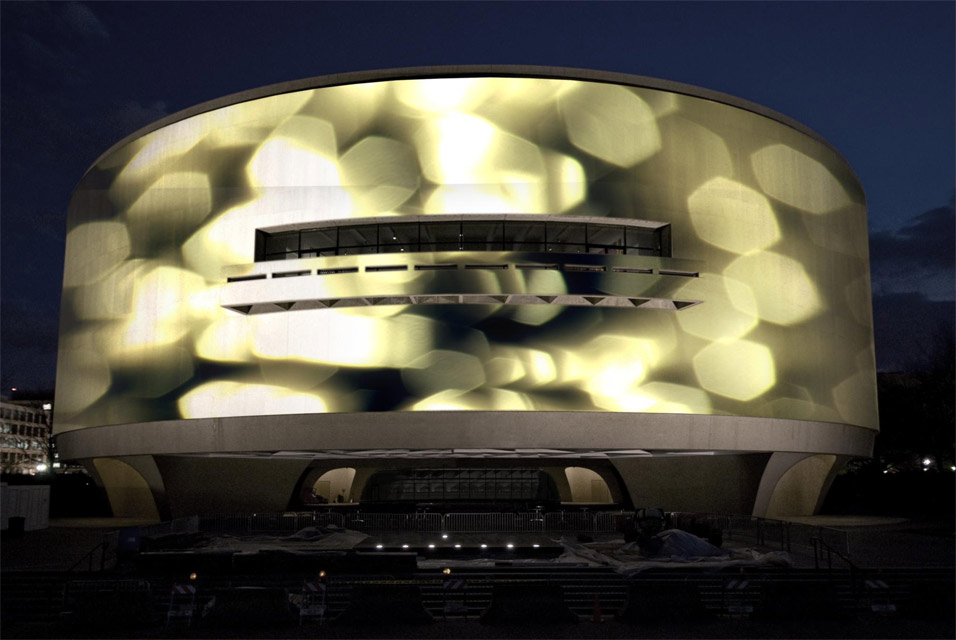
Hirshhorn 360-Degree Projection


Internationally renowned artist Doug Aitken will transform the Hirshhorn Museum and Sculpture Garden's iconic circular building into “liquid architecture.” Using approximately eleven high-definition projectors, Aitken will seamlessly blend imagery to envelop the entire façade of the Gordon Bunshaft-designed structure with a 360-degree panorama that will make the Museum recede into cinematic space—rotating, rising, and evolving into new forms. Exploding film conventions, the work cannot be viewed from any single perspective or at any single moment in time. Visitors must walk the perimeter of the building in order to experience the work more fully. 

This site-specific work will animate the Hirshhorn beginning in mid-March and remain on view each evening from March 22 to May 13, 2012, offering an unprecedented exhibition experience to the millions of visitors who will come to the National Mall during the 100th anniversary of the National Cherry Blossom Festival. A fully illustrated book about the work as well as a series of public programs—including lectures, dialogues, performances, and other events—will accompany the project. 

More than a temporary artwork, this truly original piece will also become part of the Hirshhorn’s permanent collection, enhancing its ever-expanding holdings of cutting-edge time-based media.


Saturday, December 10, 2011

I "Heart" the Art Institute of Chicago

I visited Chicago recently, staying at a kicky, new hotel, PUBLIC ChicagoA new venture by hotelier Ian Schrager, PUBLIC was an experience for a low-maintenance type of traveler, with an adorable staff, modern decor, and impeccable service. Minimalist furnishings, sleek lines, muted colors, and soft lighting carried through from the lobby and registration desk to the updated famous Pump Room restaurant and into the serene sleeping rooms. I found it to be a lovely retreat in the heart of the city on a quiet street in Chicago's Gold Coast neighborhood.

The purpose for my stay was a visit to the Art Institute of Chicago. Enamored by the Modern Wing and the nearby Millennium Park, I started my journey with Matisse's monumental masterpiece, Bathers by a River. Completed in several stages between 1909 and 1917, the immense canvas began as one of three panels commissioned for the residence of a Moscow collector. After the collector decided not to purchase the original painting, Matisse reworked the canvas again in 1913, obliterating one figure and altering the remaining nudes into abstract forms. He reworked the canvas again in 1916 and 1917 to how it is seen today. Another Art Institute treasure is the recently re-installed America Windows by Marc Chagall (seen below).  Completed in 1977, the windows commemorate the American Bicentennial in memory of the late Mayor Richard J. Daley.


No trip to the Art Institute is complete without a visit to the Thorne Miniature Rooms. Sixty-eight miniature rooms commissioned by Mrs. James Ward Thorne of Chicago were created between 1932 and 1940 according to her specifications and were painstakingly built to scale of one inch equal to one foot.  The rooms offer a glimpse of European interiors from the late 13th century to the 1930s and American furnishings from the 17th century to the 1930s.  A few of those rooms are now decked out for the holidays.  The Holiday Thorne Rooms are on view now until January 7, 2012. Add shopping on Michigan Avenue and lunch at the historic Marshall Field's (now Macy's) Walnut Room and I'm in heaven!


Thursday, August 18, 2011

On the Road to Santa Fe

Red Hills with the Pedernal
19.75 in. x 29.75 in. | Oil on Linen
Georgia O'Keeffe | 1936
I’ve heard it said the light and color in Santa Fe are beautiful. It was much more than that—it was dramatic. Expecting a brown-laden desert, I instead found an exquisite terrain of burnt umber and spots of green vegetation, mountains of blue with purple veins, and the hills bursting of orange and red. Filled with history, museums, and galleries, I found myself drawn to the landscape as much as the art. I was entranced by some stunning art at both the Georgia O’Keeffe Museum and the New Mexico Museum of Art, but I also experienced the same awe those artists drawn to the area must have felt when they absorbed it, and in turn, put to canvas their interpretation of that magnificence.

Walking in Santa Fe on a recent August evening, I looked to the sky and saw the most incredible sunset I’ve ever seen. I quickened my pace back to the hotel for my camera to try to capture that image on film. However, it was just a moment. Within minutes it had changed, and in just a few more minutes while searching frantically for the perfect vantage point, it was gone. That’s the way it was there—ever-changing and constantly evolving. I can only imagine how excited O’Keeffe, Marsden Hartley, John Marin, and scads of others artists were to transfer that imagery to canvas. I’ve long admired the work they executed with Santa Fe as their backdrop. But, it wasn’t until I visited the area that I truly appreciated what they had accomplished!

My interest in O’Keeffe has been awakened by what I learned about her and the landscape she loved. She always knew what she was meant to do, and she pursued it with passion. Departing Santa Fe in the early morning again was something special to see. From walking out of the small airport’s rust-colored adobe structure onto the tarmac, to seeing the unobstructed panoramic view of light streaked with dozens of hues of blue that seemed to emanate from the ground up while boarding the plane, and floating over the Sangre de Cristo Mountains high on the brilliance of color and the play of light—it was very surreal. I fell in love with Santa Fe.

Friday, June 17, 2011

This Week in Art | Brock, Martin, De Kooning, and Modigliani

Sometimes I can go through a spell where my work life takes over, and I'm devoid of art. I hate that. I just spent three days out-of-town for work, none of which allowed a single moment to go to an art museum I've never visited. Instead, it just sucked the life out of me and spit me back out at home Wednesday night.

However, upon re-entry, I walked into our home full of art and the studio space of my partner and artist, James Brock. It made me happy again. Then, a little time spent online steered me toward the things that save me from the tension and drudgery of work (for pay). I discovered Knox Martin's blog post on the Greenpeace website. It is Knox’s beautiful tale of a magnificent encounter with a whale and the symbolism and terror depicted in his soon-to-be executed Whaling Wall. It moved me more than Melville ever did!

Café Singer 

Oil on Canvas | 92.4 cm x 60.3 cm
Amedeo Modigliani | 1917
Lunchtime today led me to another love, Bill de Kooning, when the Hirshhorn Museum and Sculpture Garden hosted Friday Gallery Talks. For 30 minutes, a curator discussed de Kooning’s Two Women in the Country—a wildly, expressive painting executed in 1954 as his popularity was on the rise.  It was a nice way to spend a lunch, learning something new, with a dozen others with the same interest.

Finally, on Sunday I will follow yet a new interest in the troubled and short life of artist Amedeo Modigliani. The National Gallery of Art presents the author of Modigliani: A Life, Meryle Secrest with a lecture titled, "The Unknown Modigliani." I finished reading the Secrest biography last night and it was an interesting and fast read, debunking many of the widely-known and long-held myths about him. The National Gallery holdings include several beautiful examples of the artist's work in their permanent collection. Also, worth seeing is the biopic Modigliani, starring Andy Garcia, with its terribly tragic end. 

Five days and four artists that renewed my spirit and enriched my life this week.  I'm thankful for the opportunities I have to seek out this exposure to art, art history, and the artist's who bring me back to life.